
By Tony Janega
Few food categories demand more from labeling than sushi
Sushi is one of the more demanding categories for foodservice labeling because there is very little room for the process to drift. Timing windows are tight, product turnover moves quickly, and freshness expectations are high. As part of fresh food labeling, sushi has to support food safety, customer-facing information, pricing, and production flow at the same time.
That makes sushi labeling different from a basic back-of-house label. It is not happening off to the side; it is part of the production pace. Labels have to be accurate, readable, compliant, and ready immediately, often while teams are prepping ingredients, assembling rolls, restocking displays, and responding to demand throughout the day.
At smaller volumes, teams can often compensate manually. A manager catches a label issue during prep. Employees learn common expiration windows through repetition. Pricing and item details are familiar enough that small corrections can happen in the moment. As volume grows, that kind of informal correction becomes harder to sustain, and labeling can quickly become one of the clearest pressure points in the workflow.
The challenge is not just speed. It is speed under constraint
Speed matters in sushi, but speed by itself is not the real challenge. The harder part is that teams have to move quickly while working inside narrow freshness windows and strict information requirements. Sushi does not give operators much margin for delay. Product quality changes quickly, display cases need to stay full, and overproduction can turn into waste if the product does not move.
That creates a real tension in the workflow. If the team slows down too much, the case may not stay replenished during demand spikes. If the team moves too quickly without the right systems, accuracy can suffer. Labels get rushed, pricing can become inconsistent, use-by information may be unclear, and the process starts relying on employees to catch issues after they happen.
Sushi labeling should not be treated as a clerical step at the end of production. It is part of the production system itself. When labeling slows down, replenishment can slow with it. Inaccurate labels weaken food safety confidence, and inconsistent information makes the customer-facing experience harder to control.
The strongest sushi operations are not usually the ones asking teams to move faster. They are the ones removing unnecessary decisions from the workflow so speed does not have to come at the expense of accuracy.
Short shelf life makes timing a core operating variable
Every prepared food program has timing concerns, but sushi puts timing closer to the center of the operation. Freshness is visible in sushi, and customer expectations are high. That makes timing mistakes harder to absorb. A mislabeled or unclear use-by date does not just create a compliance issue. It affects how the team decides what should stay in the case, what should be pulled, what should be replenished, and how confidently managers can trust the process.
In practice, date code labeling has to be more than “good enough.” It has to be fast, legible, and dependable during real production conditions.
Manual date calculation creates a hidden burden. Employees are not just writing information down. They are interpreting time windows while also keeping production moving. During peak periods, that calculation may happen while someone is managing several other tasks at once. Even when the team is experienced, that kind of multitasking creates openings for small errors.
The problem is not that employees are careless. It is that the process asks them to carry precision in an environment built around speed. Operators often try to solve labeling mistakes with reminders, retraining, or more oversight. Those steps may help temporarily, but they do not change the workflow underneath. If the system still requires employees to calculate, write, verify, and correct information manually throughout the day, the same pressure points remain.
The rush period reveals whether the process is actually strong
A labeling process can look stable during slower production windows and still struggle when the case needs to be replenished quickly. That is especially true in sushi programs, where teams may have to respond to uneven demand throughout the day. A lunch rush can clear certain rolls or trays faster than expected. A promotion can shift product mix. A store with strong grab-and-go traffic may need frequent replenishment in short bursts rather than one predictable production cycle.
Labeling friction becomes easier to see in those moments. When a team has to stop repeatedly to handwrite labels, verify prices, check item details, or correct unclear information, the workflow loses momentum. The delay may only be seconds per item, but sushi production is sensitive to accumulation. A few seconds across many items becomes a slower restock, a less consistent display, or more pressure on the team to rush the next step.
The issue does not always look dramatic. It may be a case that is not replenished as quickly as it could be, a manager stepping in to confirm information more often than they should, or employees developing shortcuts because the official process does not fit the pace of the work.
Over time, those workarounds can become part of the operating model. Once that happens, leadership may not see a “labeling problem.” They may see labor pressure, inconsistent merchandising, missed scan issues, or avoidable waste without immediately connecting those outcomes back to the labeling workflow.
Sushi labeling sits between food safety and merchandising
Sushi labeling deserves more attention because it lives in two worlds at once. Internally, the label supports food safety, rotation, and process control. Externally, it supports customer confidence, product clarity, checkout efficiency, and increasingly important grab-and-go merchandising expectations. That dual role makes sushi labeling more demanding than a standard internal prep label.
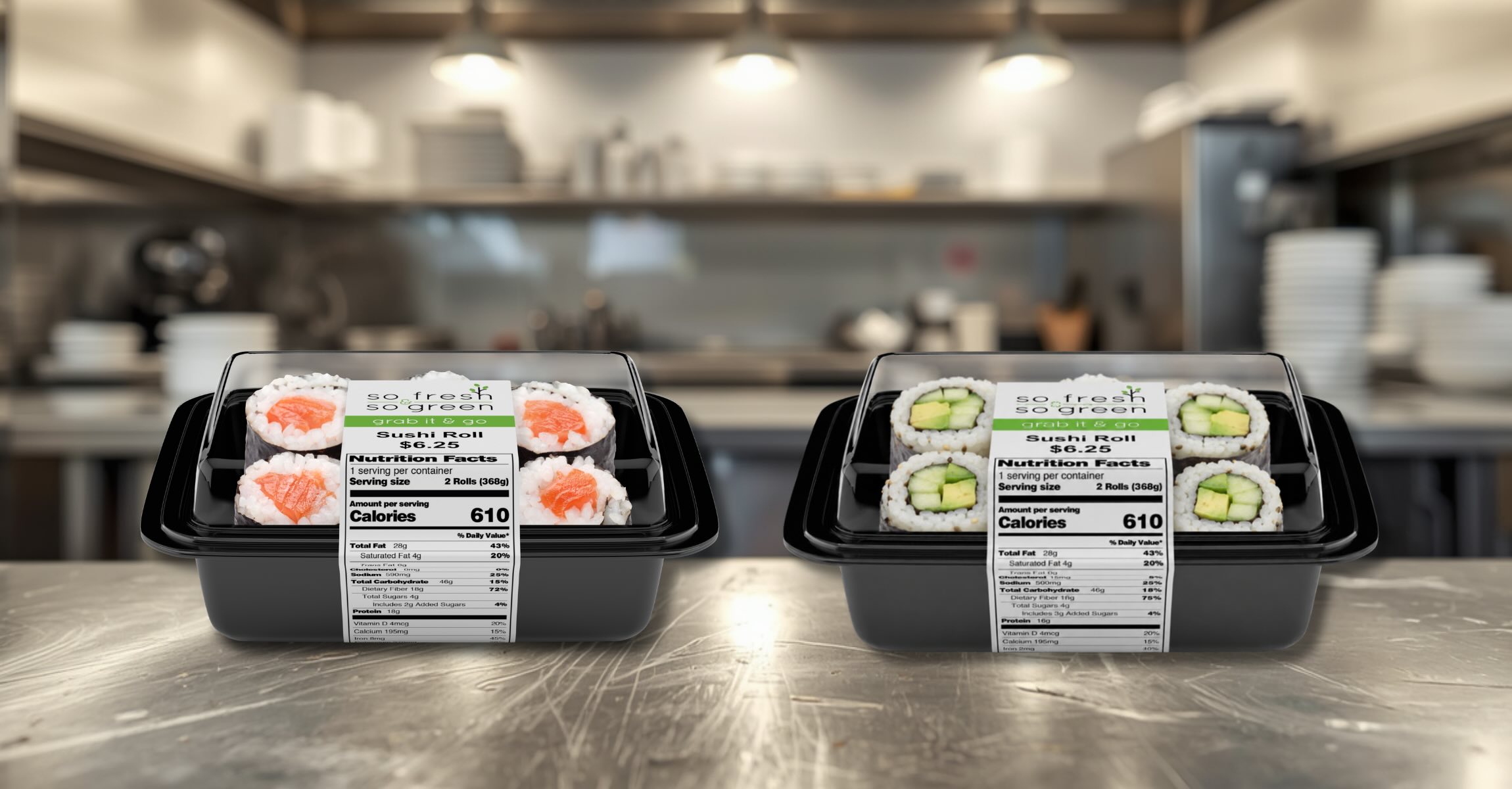
A sushi label often has to work harder than a typical prep label. It may need to carry nutrition information, pricing, barcode scanning, item identification, and freshness communication in a format that is still readable and practical on a small package. In high-volume grab-and-go sushi labeling, the label has to serve the team, the customer, and the checkout process at the same time.
It is easy to underestimate how much work that small label is carrying. The format may be small, but the requirements behind it are not.
If pricing is wrong, revenue and customer trust are affected. If barcode information is inconsistent, checkout friction increases. If nutrition or product information is incomplete, the item becomes harder to merchandise confidently. If freshness timing is unclear, the team has to rely on judgment at the exact point where the system should provide certainty. Sushi labeling is not only a compliance concern. It is part of how the product moves through the business.
Manual labeling does not fail all at once
Manual sushi labeling usually fails gradually. At first, it may only require small corrections. A manager catches a date that needs to be rewritten. A label is reprinted because the wrong price was used. A team member asks whether a product should be pulled. None of it feels significant in the moment because each issue can be fixed.
The pattern matters more than any one incident because when the same kinds of corrections happen repeatedly, the operation starts absorbing them as normal. The team expects some labels to need review. Managers expect to answer questions. Employees expect the process to slow down during busy periods. Over time, those inefficiencies become invisible because they are no longer treated as exceptions.
That is how manual processes often stay in place longer than they should. They are not always obviously broken, they are just quietly expensive. For sushi programs, that expense shows up in the form of slower replenishment, more supervision, inconsistent execution, and greater reliance on employees to remember details that a stronger system could standardize.
What strong sushi labeling systems actually support
Strong sushi labeling is not just about printing a cleaner label. It is about building a workflow where speed, accuracy, and compliance can work together instead of competing.
That means teams should not have to choose between moving quickly and labeling correctly. The process should make the correct label the easiest label to produce. It should reduce manual calculation, simplify item selection, and allow teams to move from production to packaging to display without unnecessary interruption.
One-touch label printing and pre-set templates matter because they reduce the number of decisions employees have to make during production. For a sushi program, templates can help ensure that common rolls, trays, and grab-and-go items are labeled consistently across shifts and locations. Instead of relying on employees to recreate details manually, the system can present the correct product information in a repeatable format. The deeper value is that the workflow becomes less dependent on individual memory, which makes the process easier to scale.
Where modern sushi labeling systems fit into the workflow
As sushi programs become more complex, many operators are looking for labeling workflows that reduce manual input without slowing production down. The shift is not simply about replacing handwriting with printers. It is about reducing the operational friction that builds up around repetitive labeling tasks throughout the day. In sushi environments, where teams are balancing freshness windows, replenishment speed, pricing accuracy, and customer-facing presentation simultaneously, even small interruptions can affect the rhythm of production.
In a high-volume grab-and-go sushi program, teams should not have to repeatedly calculate dates, rewrite item information, or rebuild labels during rush periods. A more standardized process keeps pricing, barcode scanning, and customer-facing product information aligned while production keeps moving.
BOHA! Labeling fits into that workflow by helping teams standardize date code labeling, grab-and-go labeling, and made-to-order labeling with pre-configured templates instead of rebuilding labels manually throughout the day. That helps keep product information clearer and more consistent without adding extra friction to the workflow.
The value is not only operational speed. It is reducing the manual correction, repeated decision-making, and workflow interruption required to keep sushi production moving efficiently during high-volume periods. As sushi programs scale, that stability matters more. The goal is not only labeling compliance; it is maintaining speed, freshness, accuracy, and consistency without forcing teams to compensate manually every step of the way.
Why consistency matters more as sushi programs expand
A single sushi station can often run on local knowledge. The team knows which items move fastest, which labels are used most often, and when the rush usually hits. That local knowledge is useful, but it is hard to replicate across a larger operation.
As sushi programs expand across locations, consistency becomes harder to maintain through training alone. Different teams may interpret timing windows differently. Product names may be abbreviated in different ways. Pricing updates may not move through every location cleanly. Managers may enforce labeling standards with slightly different expectations.
At that point, the operating model needs more structure. A standardized labeling workflow helps create a common language across the program. It gives teams a consistent way to identify products, manage timing, apply pricing, and support customer-facing information.
That consistency is useful for audits and compliance, but it also affects how confidently the entire program can scale. Without that structure, growth tends to create variation. With it, teams have a stronger foundation for keeping the program consistent.
The real goal is fewer interruptions
When operators think about improving labeling, the conversation often starts with accuracy. Accuracy is essential, but the broader operational goal is fewer interruptions.
A strong sushi labeling system reduces the number of moments when employees have to pause, verify, rewrite, recalculate, or ask for clarification. Those interruptions are what slow the workflow down and create opportunities for inconsistency. Reducing them helps the team maintain flow without sacrificing control.
That matters in sushi operations because the work is highly sequential. Production, packaging, labeling, merchandising, and rotation all depend on each other. When one step becomes unreliable, the impact moves downstream.
A better labeling workflow does not just improve the label. It protects the rhythm of the operation.
Scaling sushi programs without slowing service
Sushi programs ask a lot from operators. They require freshness discipline, visual consistency, food safety confidence, accurate pricing, clear customer information, and fast replenishment. None of those requirements exists in isolation. They overlap every day in the workflow.
Sushi labeling deserves more attention than it often receives. Slow, unclear labeling that depends too heavily on manual correction can become a constraint on the program. A standardized process that fits the way teams already work can support better execution.
For operators expanding sushi programs, the question is not simply whether labels are being applied. It is whether the labeling process can keep up with the speed, precision, and visibility the category requires.
Sushi labeling done right is not only about compliance. It is about helping freshness, accuracy, and service speed hold together when operational pressure increases.
Frequently asked questions about sushi labeling in foodservice
Below are a few common questions about sushi labeling, date code labeling, grab-and-go sushi, and how foodservice operators can keep labeling workflows consistent as programs grow.
What is sushi labeling?
Sushi labeling is the process of labeling prepared sushi products with the information needed to manage freshness, food safety, pricing, product identification, and checkout. In foodservice environments, sushi labels often have to support the team preparing the product and the customer choosing it at the same time.
Why is sushi labeling more complex than standard prep labeling?
Sushi labeling is more complex because the product moves quickly, freshness windows are tight, and the label often carries more information than a basic prep label. A sushi label may need to support date coding, item identification, pricing, barcode scanning, nutrition information, and customer confidence in a small package format.
How does date code labeling support sushi freshness and food safety?
Date code labeling helps teams track when sushi was prepared, how long it can remain in rotation, and when it should be pulled from sale. Clear date code labeling reduces the need for employees to calculate timing manually or make judgment calls during busy production periods.
Why does grab-and-go sushi labeling matter for convenience stores and foodservice operators?
Grab-and-go sushi labeling matters because the label has to support the team preparing the product, the customer choosing it, and the checkout process scanning it. When sushi labels are clear and consistent, they help improve product clarity, pricing accuracy, food rotation, and the overall grab-and-go experience.
What should operators look for in a sushi labeling system?
Operators should look for a sushi labeling system that supports fast label creation, consistent date coding, clear product information, barcode scanning, and repeatable workflows across shifts and locations. For growing sushi programs, the goal is not only to print labels faster, but to reduce manual decisions that can slow production or create inconsistency.