
TransAct Technologies | BOHA Built
Why execution is the focus at Booth 7250
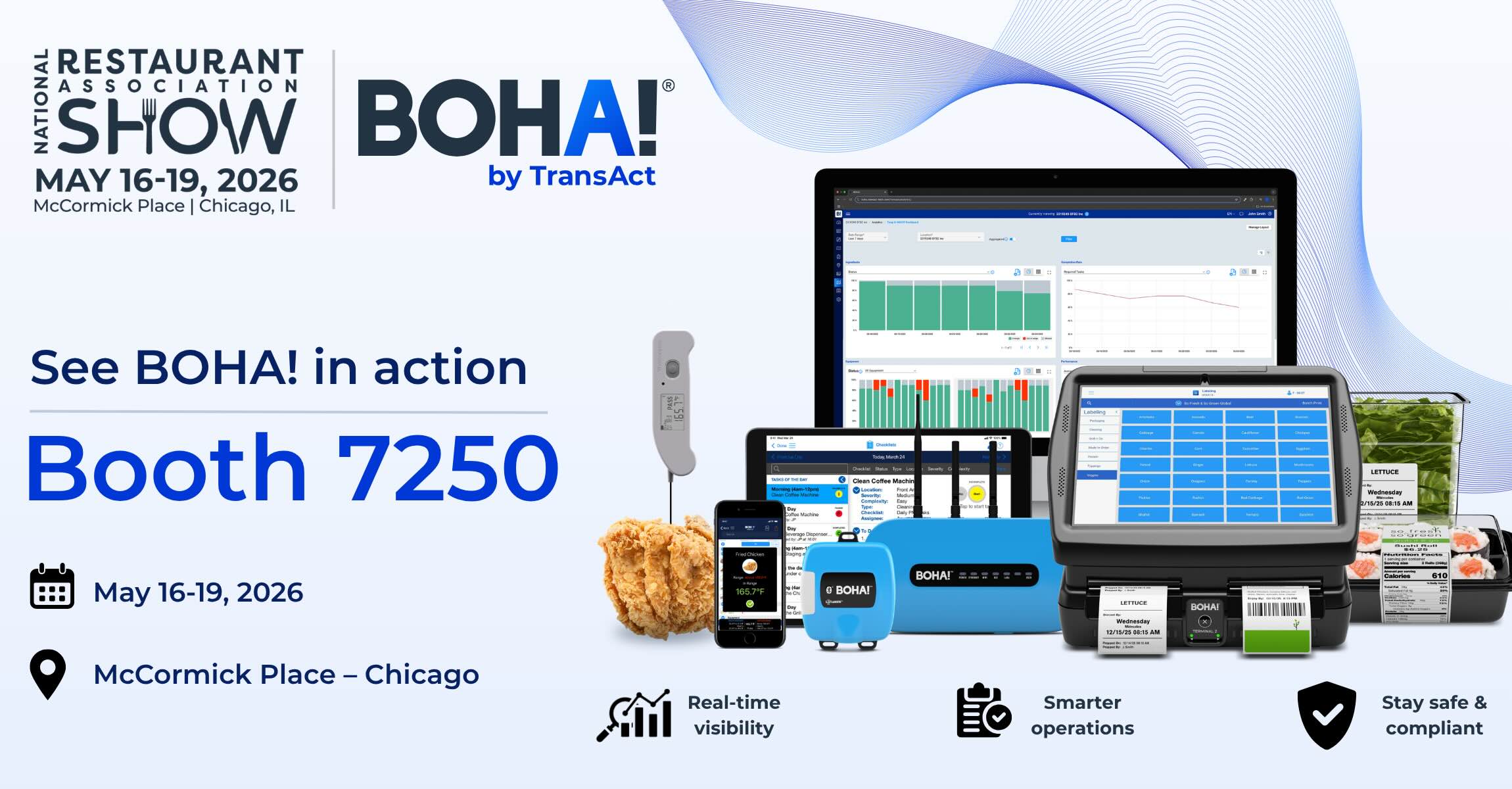
The National Restaurant Association Show 2026 is where foodservice operators go to see what is next, compare what is working, and find tools worth bringing back into the business. The show takes place May 16–19 at McCormick Place in Chicago. We will be at Booth 7250 with BOHA! by TransAct showcasing our connected back-of-house operations platform designed to help foodservice teams improve labeling, checklists, temperature monitoring, equipment visibility, and multi-location execution.
For restaurant, convenience store, and foodservice operators, the challenge is rarely a lack of effort inside the kitchen. Teams are already working hard. Managers are already trying to keep up. Corporate leaders are already looking for better ways to improve food safety, reduce waste, control labor, and support consistent execution across locations through more centralized kitchen workflow management systems.
The harder problem is that back-of-house work is still often managed through a patchwork of tools, paper processes, manual follow-up, disconnected systems, and tribal knowledge.
One location may have a strong process for food prep labeling. Another may still rely on handwritten labels on strips of masking tape or inconsistent date coding. One team may be diligent with opening and closing checklists, while another completes tasks differently depending on who is working that shift. Temperature logs may be tracked on paper, equipment issues may not be noticed until product is already at risk, and managers may spend too much time chasing updates instead of improving the operation.
That is where BOHA! is designed to help.
BOHA! by TransAct is a connected back-of-house operations platform designed to help foodservice teams run more consistent, efficient operations across every location. From food safety and labeling to task management, timers, and equipment monitoring, BOHA! brings software, purpose-built hardware, and operational visibility together in one system built for daily kitchen execution.
At the National Restaurant Association Show, operators can see how BOHA! works across the full back-of-house environment — not as a single tool, but as a practical system for improving how work gets done.
A smarter way to manage back-of-house restaurant operations
Every foodservice operation depends on repeatable execution. Individually, each of these workflows may seem manageable. But across multiple shifts, multiple teams, and multiple locations, consistency becomes much harder to maintain.
That is where many operators begin to feel the limits of paper-based processes or disconnected point solutions. A checklist tool may help track tasks, but it does not necessarily solve labeling. A labeling system may improve accuracy at the prep station, but it may not connect to broader kitchen workflows. A temperature monitoring system may support compliance, but it may not give operators a full picture of how execution is happening across the back of house.
BOHA! is built around a different idea: kitchen execution becomes simpler when the systems behind it are designed to work together.
Instead of treating labeling, checklists, timers, food prep, temperature logging, equipment monitoring, and reporting as separate problems, BOHA! connects these workflows through a unified platform. That gives teams a more practical way to standardize daily execution while giving managers and operators better visibility into what is happening across their locations.
For operators searching for foodservice back-of-house software or a more connected restaurant operations software solution, this is the shift that matters: making everyday execution easier to manage at scale.
Why connected kitchen workflows matter
Back-of-house complexity tends to build quietly.
A missed label, skipped checklist task, late temperature log, or cooler drifting out of range may not seem like a major issue in the moment. But across shifts and locations, those small execution gaps can lead to more waste, more labor drag, more food safety risk, and less confidence in what is happening across locations.
For multi-location brands, the challenge becomes even greater. Leaders are not just managing one kitchen. They are trying to create reliable processes across dozens, hundreds, or even thousands of locations.
That is why the conversation around kitchen technology is moving beyond individual tools. Operators are asking whether their systems can support the way work actually happens in the kitchen: guiding teams in the moment, reducing unnecessary manual work, and giving managers enough visibility to spot issues before they become recurring problems.
BOHA! was designed for that environment, supporting the workflows foodservice teams rely on every day while helping operators build a more consistent foundation for food safety, prep accuracy, task completion, and operational oversight.
The BOHA! platform: Bringing back-of-house workflows into one ecosystem
BOHA! is built around the everyday work that keeps foodservice operations moving, from checklists and food prep to temperature logging, equipment visibility, labeling, and reporting.
These workflows may seem small on their own, but together they shape how consistently teams execute across shifts, locations, and operating formats.
BOHA! helps bring those workflows into one application-driven ecosystem. Purpose-built for multi-unit restaurants, convenience stores, foodservice providers, sushi operations, and other high-volume foodservice environments, BOHA! helps teams replace paper, reduce time spent on repetitive back-of-house tasks, and stay more focused on food, service, and operational consistency.
That flexibility matters because operators do not all need to start in the same place. Some may begin with digital checklists to improve task completion. Others may focus first on food prep workflows, temperature logging, equipment visibility, or labeling. Many BOHA! applications can run on tablets and smartphones, giving operators a practical way to introduce digital execution without requiring specialized hardware for every workflow.
Labeling remains an important part of the BOHA! ecosystem, especially for operators managing prepared foods, date coding, rotation, grab-and-go items, sushi labeling, and food safety requirements. With BOHA! Labeling, teams can create accurate labels directly in the kitchen using BOHA! purpose-built printer hardware, including BOHA! T2 and BOHA! WorkStation. Because labeling depends on reliable printing in a demanding foodservice environment, this is the workflow where BOHA! hardware plays a specific role.
But the larger value is not the printer by itself. It is how labeling fits into a broader restaurant operations software platform built to support daily execution. When these workflows are connected through the same ecosystem, operators gain a more practical way to standardize work across locations without treating each process as a separate operational problem.
For operators looking for foodservice back-of-house software, a kitchen workflow management system, or a multi-location restaurant operations platform, that connected model is what makes BOHA! different. It helps operators improve individual workflows while building toward a more scalable way to manage back-of-house execution.
From daily tasks to stronger execution
Daily task management is one of the clearest places where back-of-house complexity shows up.
In most foodservice operations, there are countless tasks that need to happen every day: opening procedures, closing routines, cleaning checks, food safety tasks, prep work, equipment checks, brand standards, manager verifications, and shift-specific responsibilities.
When those tasks are managed on paper, managers may not have enough insight into when work happened, who completed it, what proof was captured, or whether the same issue is showing up across multiple locations.
BOHA! Checklist helps move those workflows into a digital format that is easier to customize, follow, track, and manage. Operators can build checklists around the way their teams actually work, whether that means opening and closing procedures, food safety checks, cleaning routines, prep tasks, or location-specific operating standards.
That customization is important because not every operation runs the same way. A convenience store foodservice program may need different daily checks than a multi-unit restaurant, contract foodservice operation, or sushi program. BOHA! Checklist gives operators a more flexible way to standardize execution without forcing every location into a one-size-fits-all process.
It also gives teams more context inside the workflow itself. Tasks can include videos, photos, and notes, helping employees understand what needs to be done while giving managers a clearer record of completion. That added visibility helps support accountability without relying only on verbal follow-up, paper checklists, or end-of-shift reviews.
For multi-location operators, centralized updates can make an even bigger difference. When a new task, procedure, or requirement needs to be added, updates can be managed through BOHA! Control Center and pushed across locations. That helps teams stay aligned without manually updating paper checklists or depending on each location to interpret changes on its own.
That time savings can be significant. BOHA! Checklist has helped operators save an average of 16.5 hours per week, per location — time that can be redirected from chasing paper-based processes toward coaching teams, improving execution, and staying ahead of issues before they affect the business.
For operators comparing restaurant task management software, restaurant checklist software, or a kitchen task management system, the value is not simply that tasks become digital. The value is that task completion becomes easier to verify, easier to standardize, and easier to manage across locations.
Supporting food safety and compliance without adding friction
Food safety depends on employees following the right steps, at the right time, in the right way. That includes accurate labeling, reliable temperature tracking, documented procedures, clean handoffs between shifts, and enough visibility for managers to know whether those processes are actually happening.
Paper logs can be incomplete. Manual temperature checks can be missed. Labels can be inconsistent. Documentation may only become important when an audit, inspection, or incident forces the team to go back and prove what happened.
BOHA! helps operators make food safety workflows part of daily execution instead of treating them as separate administrative burdens.
That is especially important for temperature logging. In many kitchens, temperature checks are still recorded by hand, which can make it harder to verify whether checks happened on time, identify missed readings, or maintain a consistent record across shifts and locations.
BOHA! Temp gives teams a digital way to complete and document temperature checks as part of their normal workflow. Instead of relying on paper logs that can be misplaced, incomplete, or difficult to review later, operators can create a more reliable record of temperature activity across the operation.
That also supports HACCP-focused food safety processes. For operators managing critical control points, corrective actions, and inspection readiness, digital temperature logs can make it easier to document that the right checks were completed and that issues were addressed when they appeared.
The value is not only better documentation. It is better follow-through. When temperature logging becomes part of a guided digital workflow, teams have a clearer process to follow, and managers have a better way to verify completion without sorting through paper records after the fact.
BOHA! Checklist and BOHA! Labeling support that same food safety foundation. Checklist can help teams manage food safety tasks, cleaning procedures, opening and closing routines, and inspection readiness. Labeling helps improve accuracy around prepared food labels, date coding, rotation, grab-and-go items, and other kitchen labeling workflows.
Together, these workflows support a more practical approach to restaurant compliance software and food safety software for restaurants. The goal is not to make compliance feel heavier. The goal is to make the right behaviors easier to complete, easier to document, and easier to verify.
Real-time equipment visibility with BOHA! Sense
Some back-of-house problems are easy to see. Others are not.
A missed prep task may show up during service. A labeling mistake may be caught when product is pulled. But equipment issues can develop quietly. A cooler or freezer may drift out of range before anyone notices. By the time the problem is discovered, product may already be at risk.
BOHA! Sense helps address that challenge with IoT-powered equipment monitoring.
With BOHA! Sense, operators can monitor critical equipment such as coolers, freezers, and storage areas. The system helps provide real-time visibility into equipment conditions, allowing teams to catch issues earlier and respond before they lead to product loss, downtime, or food safety concerns.
That visibility is especially valuable for managers responsible for multiple locations. Instead of waiting for someone on-site to notice a problem, managers can view temperature activity across locations and respond when equipment moves out of range. The impact can be immediate. In a real-world customer scenario, an after-hours refrigerator issue was caught quickly enough for the team to get on-site, alert the right people, and save more than $10,000 in product that may otherwise have been lost.
For operators searching for temperature monitoring for restaurants, freezer temperature monitoring systems, cooler temperature monitoring systems, or food temperature monitoring systems for restaurants, the value is not just measurement. It is awareness.
A temperature monitoring system becomes more useful when it helps operators take action. BOHA! Sense supports that by helping teams stay ahead of equipment-related risk instead of reacting after a problem has already affected the business.
Built for teams in the kitchen and leaders above the store
Back-of-house technology has to work for the employee using it during a busy shift and for the leaders responsible for consistency across locations. If a system is too complicated for the kitchen or too limited for above-store visibility, it may not solve the larger operational challenge.
BOHA! is designed to support both.
For kitchen teams, the focus is on making execution simpler. The platform helps guide employees through workflows such as labeling, checklists, timers, food prep, equipment monitoring, and temperature logging, while BOHA! Media gives staff on-demand access to training videos, recipe cards, food prep instructions, and equipment manuals. That kind of support can be especially valuable when teams need clear direction in the moment, without waiting for a manager, trainer, or executive chef to be there in person. The purpose-built hardware is designed for demanding kitchen environments where speed, durability, and ease of use matter.
For leaders, BOHA! Control Center provides visibility into activity across locations and makes it easier to keep teams aligned as procedures change. Operators can better understand whether workflows are being completed, where gaps may exist, and where processes may need improvement. They can also push important updates across locations more efficiently, helping teams stay consistent without relying on separate emails, printed instructions, or location-by-location follow-up.
That combination is what makes BOHA! a stronger fit for multi-location restaurant operations. It supports the work happening in the kitchen while helping leaders manage consistency at scale.
A platform that can grow with the operation
Not every operator starts in the same place. Some may begin with software-only workflows for checklists, food prep, temperature logging, or reporting. Others may need to improve labeling with BOHA! printer hardware, labels, and consumables. Others may expand into BOHA! Sense for equipment visibility.
That flexibility matters because technology adoption in foodservice rarely happens all at once. Operators need solutions that solve immediate problems without forcing unnecessary disruption. Over time, the value grows as more workflows connect through the same platform.
That is part of what makes BOHA! different. It is not just task software. It is not just labeling hardware. It is not just equipment monitoring. It is a connected platform supported by foodservice-specific applications, purpose-built hardware where it matters, label expertise, and operational visibility.
What operators can experience at the show
At Booth 7250, National Restaurant Association Show attendees can see how BOHA! supports real kitchen workflows across labeling, checklists, temperature logging, equipment monitoring, food prep, training content, and centralized visibility.
Operators can also see how BOHA! purpose-built hardware, including BOHA! T2 and BOHA! WorkStation, fits into the kitchen environment. These devices are engineered for the speed, durability, and simplicity that foodservice teams need during real shifts.
For operators trying to reduce waste, improve food safety, streamline prep, standardize execution, and gain better visibility across locations, BOHA! offers a more connected way to manage the back of house.
Ready to see BOHA! in action?
The National Restaurant Association Show is built around practical innovation — the kind operators can evaluate, test, and bring back to their teams.
For foodservice leaders, that makes it the right place to look closely at how back-of-house execution is changing. Whether you are focused on labeling, checklists, food safety, equipment monitoring, prep workflows, or multi-location visibility, BOHA! gives operators a platform for improving execution where it matters most: inside the kitchen.
See BOHA! in action at the National Restaurant Association Show 2026, May 16–19, at Booth 7250.