
By Stephen Crump, Head of Product Management, TransAct Technologies | BOHA! Built
When refrigeration problems go unnoticed
When refrigeration problems go unnoticed, they can create food safety risks, inventory losses, and documentation headaches no operator wants during a compliance review.
BOHA! Sense helps teams listen before small problems get loud. For many operators, refrigeration monitoring is becoming an important part of how they protect product, support food safety documentation, and understand equipment issues earlier.
Recently, I read a piece of news that broke my foodservice-tech heart.
Kroger agreed to pay a $2.5 million civil penalty and spend an estimated $100 million over three years to reduce coolant leaks, upgrade refrigeration equipment, and improve company-wide compliance with Clean Air Act requirements. According to Grocery Dive, the proposed settlement, which involved the U.S. Department of Justice and the Environmental Protection Agency, also requires Kroger to retrofit or replace 600 refrigeration units.
This is a very specific case, and it is always easier to connect the dots after the fact.
But one thought was hard to ignore: refrigeration problems can become very expensive when operators cannot see them early enough.
Real-time refrigeration monitoring helps foodservice operators reduce risk by alerting teams when refrigerators, freezers, walk-ins, or dry storage areas move outside normal temperature or humidity ranges. That early warning can help teams protect product, investigate equipment issues, support food safety documentation, and respond before a small issue becomes a larger operational cost.
BOHA! Sense is not a refrigerant leak detector
Now, let’s be clear about what BOHA! Sense does and does not do.
BOHA! Sense is not a refrigerant leak detector. It is not designed to diagnose coolant leaks directly or replace HVAC/R service, refrigerant management, or preventive maintenance programs.
What it does give operators is something foodservice, grocery, convenience, and multi-location brands need more of: real-time visibility into the health of their refrigerated environments.
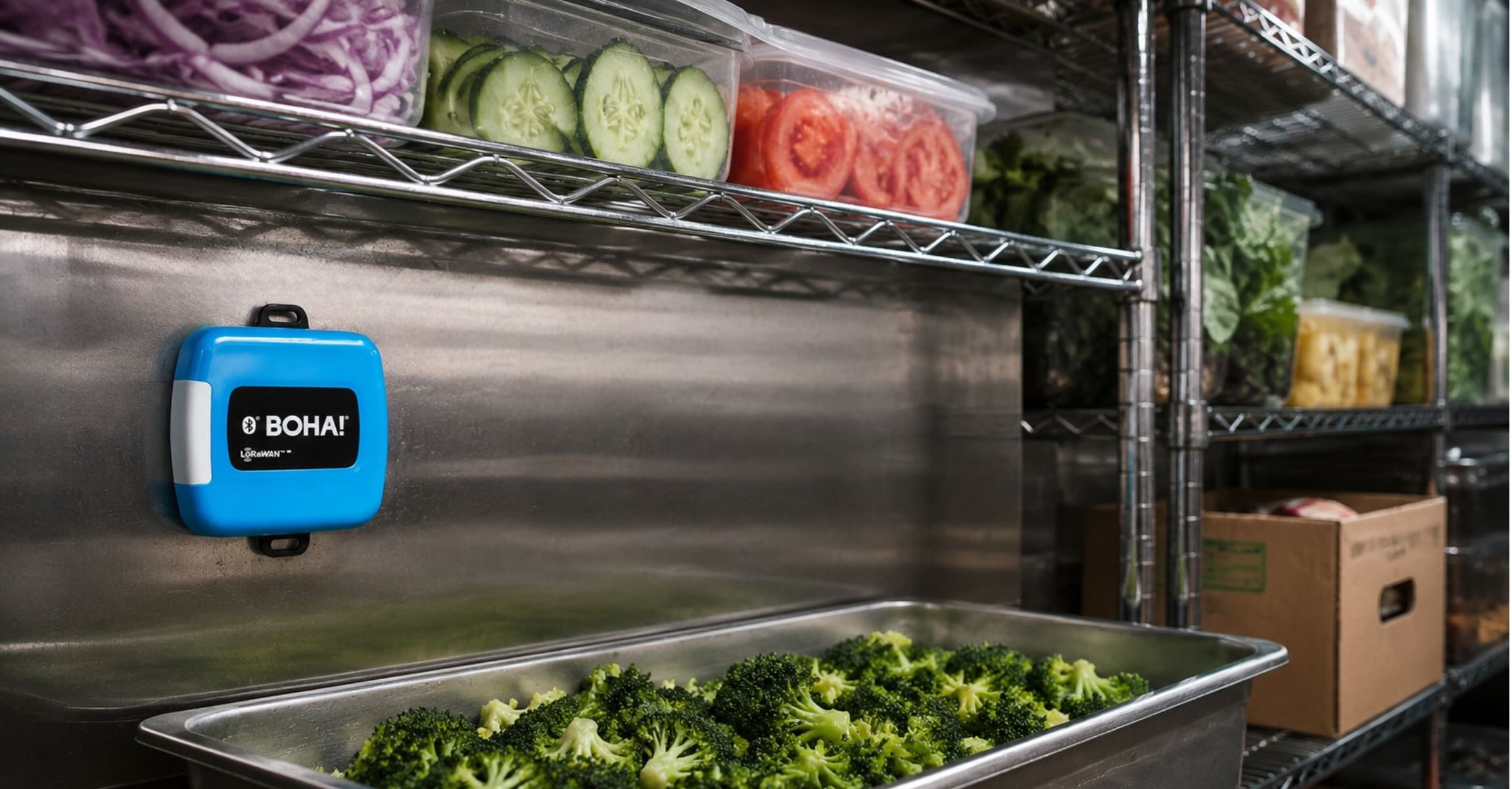
BOHA! Sense is TransAct’s real-time temperature and humidity monitoring solution for refrigerators, freezers, walk-in equipment, and dry storage areas. The system monitors temperature and humidity conditions and lets teams know when equipment moves outside its normal range, so they can take action before a problem turns into costly food loss, operational disruption, or a bigger maintenance issue.
In other words, BOHA! Sense helps your fridges talk.
More importantly, it helps your team listen.
When refrigeration conditions start to drift
Refrigeration issues are easy to underestimate because they do not always look like failures at first.
A cooler may still be running, just a little warmer than it should. A freezer may still be holding product but taking longer to recover after deliveries or heavy use. A walk-in may seem fine during a quick check, even though the temperature or humidity pattern has been drifting outside its normal range overnight.
In a busy foodservice environment, those changes are easy to miss. The equipment has not stopped working. The team has not seen an obvious failure. The issue may not show up until product quality is affected, inventory has to be discarded, or someone starts asking what the records actually show.
Real-time monitoring gives teams consistent, “always on” visibility, not just at the moment someone records a temperature during a manual check. When conditions start moving outside the expected range, teams can respond while there is still time to protect product, check the equipment, or escalate the issue.
Refrigeration problems often start as small changes in conditions, but the impact can grow and spread, affecting food safety, product loss, service disruption, maintenance planning, and compliance documentation.
Recent headlines are a reminder of how expensive refrigeration issues can become when they are difficult to see, track, or address early.
The useful part is not just the alert
With BOHA! Sense, operators can monitor temperature and humidity trends across critical equipment, receive alerts when conditions move out of range, and build a history of what is happening over time.
That history helps teams understand whether an issue is isolated, recurring, or part of a larger pattern across locations. A facilities leader may see a piece of equipment that is struggling before it ultimately fails. A food safety leader may have better documentation and fewer unknowns. An operator may catch a problem before product quality, food safety, or guest experience is affected.
For a multi-location brand, the picture gets even bigger. Patterns that look like isolated store-level issues can start to show up across equipment, locations, or regions.
Visibility with BOHA! Sense is not just knowing that a refrigerator is warm right now. It is understanding whether the issue is getting better, worse, or starting to repeat.
In foodservice, early response makes a big difference.
What refrigeration monitoring helps operators see sooner
A foodservice temperature monitoring system is not just about catching one equipment issue. It helps teams see the small changes that can turn into larger operational problems if no one catches them in time.
A cooler running warm between checks, a freezer recovering slowly after deliveries, recurring “one-off” issues, missing documentation, and product loss risk all become easier to manage when teams can see what is happening earlier and over time.
Refrigeration monitoring does not replace people. It gives them better information sooner.
Small refrigeration issues can become expensive at scale
The lesson from the Kroger news is not that every operator is facing the same situation. It is that refrigeration issues can scale quickly when they are hard to see, hard to track, or hard to connect across locations.
BOHA! Sense would not have diagnosed a refrigerant leak. That is not what it was built to do. But real-time temperature and humidity monitoring can help operators notice when refrigerated environments are no longer behaving normally.
The cost of refrigeration problems is rarely limited to the equipment itself. It can show up as discarded product, missed documentation, added labor, service disruption, and maintenance calls that keep coming back because no one has connected them into a larger pattern.
When that happens across many locations, the cost can grow quickly.
A small monitoring investment in BOHA! Sense is a very different conversation than a nine-figure refrigeration surprise.
From reactive maintenance to proactive monitoring
Many foodservice teams still rely on manual checks, paper logs, and employee observation to catch refrigeration problems.
Those practices are not inherently wrong, but they are limited.
Someone may record a normal temperature at 9 a.m., but that does not tell the team what happened overnight, during a lunch rush, after a delivery, or across other locations. By the time a manager knows there is a problem, the issue may already have affected product, documentation, or the next service call. For corporate teams, those small site-level issues can stay buried unless the data makes it back in a way they can actually use.
Real-time refrigeration monitoring gives teams more to work with than a single reading at a single moment. When conditions start moving outside the expected range, teams can see when the change happened, how often it happened, and whether the same issue is starting to repeat.
The bigger the operation, the more important it becomes to move from reactive maintenance to proactive monitoring.
Your equipment may already be trying to tell you something. The real question is whether anyone is listening.
BOHA! Sense helps foodservice teams listen before small problems get loud.
Frequently asked questions about refrigeration monitoring
Below are a few common questions about refrigeration monitoring, BOHA! Sense, and how real-time temperature and humidity visibility can help foodservice teams reduce risk and protect product.
Does BOHA! Sense detect refrigerant leaks?
No. BOHA! Sense is not a refrigerant leak detector. It monitors temperature and humidity conditions in refrigerators, freezers, walk-ins, and dry storage areas. If conditions move outside their normal range, teams can receive alerts and investigate what may be causing the change.
How does real-time refrigeration monitoring help reduce food loss?
Real-time refrigeration monitoring helps teams catch temperature or humidity changes before they affect product quality or food safety. When equipment starts moving outside its expected range, teams can respond sooner by checking the equipment, moving product, or escalating the issue.
Can refrigeration monitoring help operators understand why equipment keeps running warm?
Yes. Temperature history can help operators see whether one cooler, freezer, or walk-in is consistently running warmer than others. Sometimes the issue is not a full equipment failure. It may be tied to heavy traffic, frequent door openings, placement near a warmer area, or another condition that makes the equipment work harder. With better visibility, teams can decide whether to service the equipment, adjust operations, move product, or add controls such as strip curtains or freezer shutters to help keep cold air in and warm air out.
Does BOHA! Sense replace manual temperature reporting?
BOHA! Sense helps operators move away from handwritten temperature reporting by automatically capturing temperature and humidity data from monitored equipment. Instead of relying only on a single reading written down at one point in time, location teams can see alerts when conditions move out of range, and corporate teams can review trends across equipment and locations.
That does not remove the need for clear food safety procedures. It helps operators modernize how those procedures are carried out, documented, and managed across the kitchen.