
By Stephen Crump, Head of Product Management, TransAct Technologies | BOHA! Built
When repeated labeling work starts to shape the shift
In a busy foodservice operation, labeling is part of the normal rhythm of the shift. It comes up during prep, storage, cooler resets, product rotation, grab-and-go production, and the handoff between one team member and the next.
The label itself changes depending on the item. A prepped ingredient needs a date-code label with clearly visible use-by information. A packaged salad, sushi tray, or sandwich needs important ingredient, allergen, nutrition details, and maybe also a barcode on their grab-and-go label. With each use, the exact format changes, but the need is the same: the team has to produce the right label quickly, clearly, and consistently while the rest of the operation keeps moving.
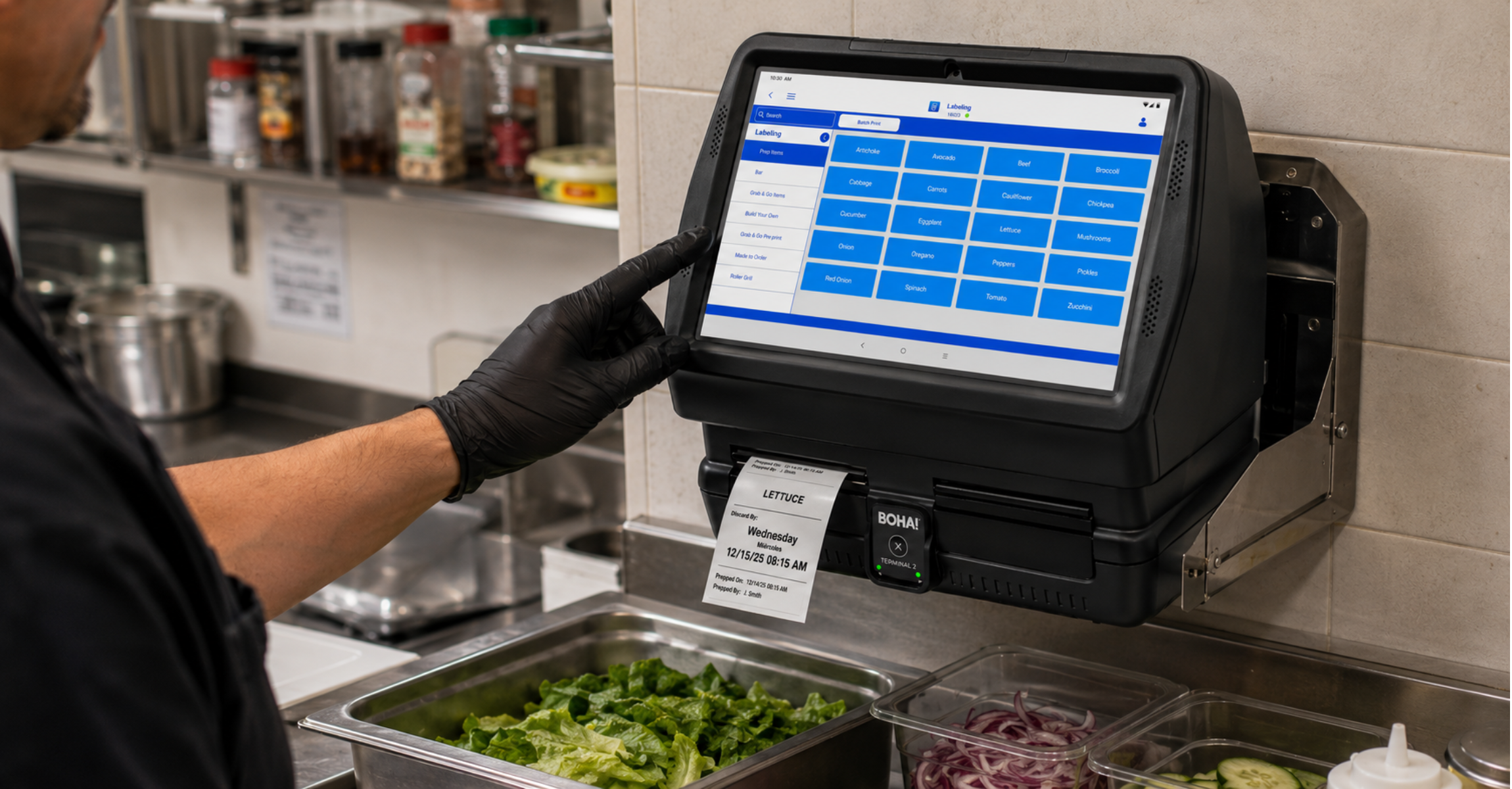
BOHA! T2, formerly known as BOHA! Terminal 2, was built for that kind of repeated labeling work, where consistency and accuracy are important throughout the shift. As a fixed back-of-house terminal and high-volume label printer, BOHA! T2 supports foodservice labeling workflows through BOHA! Labeling. Teams can use it to manage prep, storage, food rotation, grab-and-go, and related labeling needs from one central station. In simple terms, BOHA! T2 gives foodservice teams a fixed touchscreen-and-printer station for producing consistent labels during daily back-of-house work.
T2 is not the entire BOHA! solution. It is the front door into a broader automated food labeling system. As hardware, its role is practical and immediate: it gives operators a reliable, fixed, approachable place where staff can go to print the right label at the right time.
For operations that want the screen and printer to stay together in one reliable location, T2 acts as the fixed labeling hub. Staff know where to go, managers know where the workflow lives, and the labeling process is not dependent on a loose tablet, a disconnected printer, or a handwritten workaround when the shift gets busy.
High-volume labeling needs a fixed home
Food labeling can look simple from the outside. A label gets printed, applied, and the team moves on.
Inside the back-of-house, the process is more demanding.
Labels need to be available when the work is happening. Staff need to find the right item, select the correct workflow, print clearly, and apply the label without slowing down the rest of the shift. The process must work during prep windows, rush periods, shift changes, product changeovers, training cycles, inspections, and high-volume production.
When a task happens that often, inconsistency becomes expensive. If staff need to search for a device, reconnect a printer, confirm which tablet is paired, find the right roll of labels, or decide whether to handwrite something instead, the labeling process starts to drift.
That drift can show up in small ways: labels printed late, items marked differently by different employees, handwritten dates that are hard to read, or teams relying on memory instead of a standard workflow.
With BOHA! T2, the repetitive work of labeling has a dedicated station that contains and speeds along the work, ensuring consistency, rather than something staff have to scramble to complete in a mess of tape and markers the midst of a busy shift.
For high-volume food prep and labeling workflows, that consistency is practical. The more often labeling happens, the more important it is for the process to be easy to find, easy to follow, and easy to repeat.
The role of fixed hardware in back-of-house operations
Not every operation wants mobile hardware moving throughout the kitchen.
Some teams do need a screen that can move with the work, and we’ll cover BOHA! WorkStation later in this series. BOHA! T2 serves a different operating model: the screen and printer stay together in one fixed station, giving teams a clear place to manage high-frequency labeling.
That can be especially useful in environments where operators want tighter control over how shared hardware is used. Some kitchens have high staff turnover, fast-moving shifts, newer employees, or highly standardized roles where the simplest path is often the most reliable one. In those settings, a fixed terminal helps reduce extra variables around where the device is, who has it, whether it is charged, or whether it has been moved away from the labeling station.
The best way to understand BOHA! T2’s role in the kitchen space is as the anchored labeling hub for the back-of-house.
It’s the physical place where labeling workflows come together for frontline staff. The touchscreen and printer stay together, so a new employee does not have to understand the hardware setup before they can follow the process. They can go to the station, select the right label workflow, print the label, and get back to the task.
That may sound simple, but in a high-frequency environment, simplicity is an operational benefit. The more often a task happens, the more important it is for that task to be repeatable.
Labeling is not a once-a-day process. It’s part of how food is prepared, stored, packaged, merchandised, and sold throughout the shift. A fixed system helps make labeling part of the kitchen’s normal rhythm, instead of a time consuming process staff have to piece together while the operation is already moving.
For operations that want the screen and printer anchored together, T2 supports a controlled, repeatable food prep and labeling workflow from one shared back-of-house station.
One station for different food labeling needs
BOHA! T2 is not valuable because it prints one kind of label. Its value comes from giving teams one fixed station for the different labeling needs required for prep, storage, merchandising, and customer-facing food programs. Depending on the operation and label configuration, BOHA! T2 can support a range of food prep and labeling workflows, label details, and media types.
Common labeling workflows include:
- Date-code labeling
- Grab-and-go labeling
- Made-to-order labeling
- Batch printing
- Custom label designs
Supported label details and media can include:
- Nutritional fact panels
- Ingredient listing
- Adaptable Barcodes
- Multi column labels to support party trays
- Dissolvable labels
- Permanent labels
- Removable labels
- Removable film labels
- Variable-length label media
In practice, the workflows and labeling types noted above are not always needed in every situation. For teams managing prep, storage, and food rotation, date-code labeling is often the most repeated workflows T2 supports.
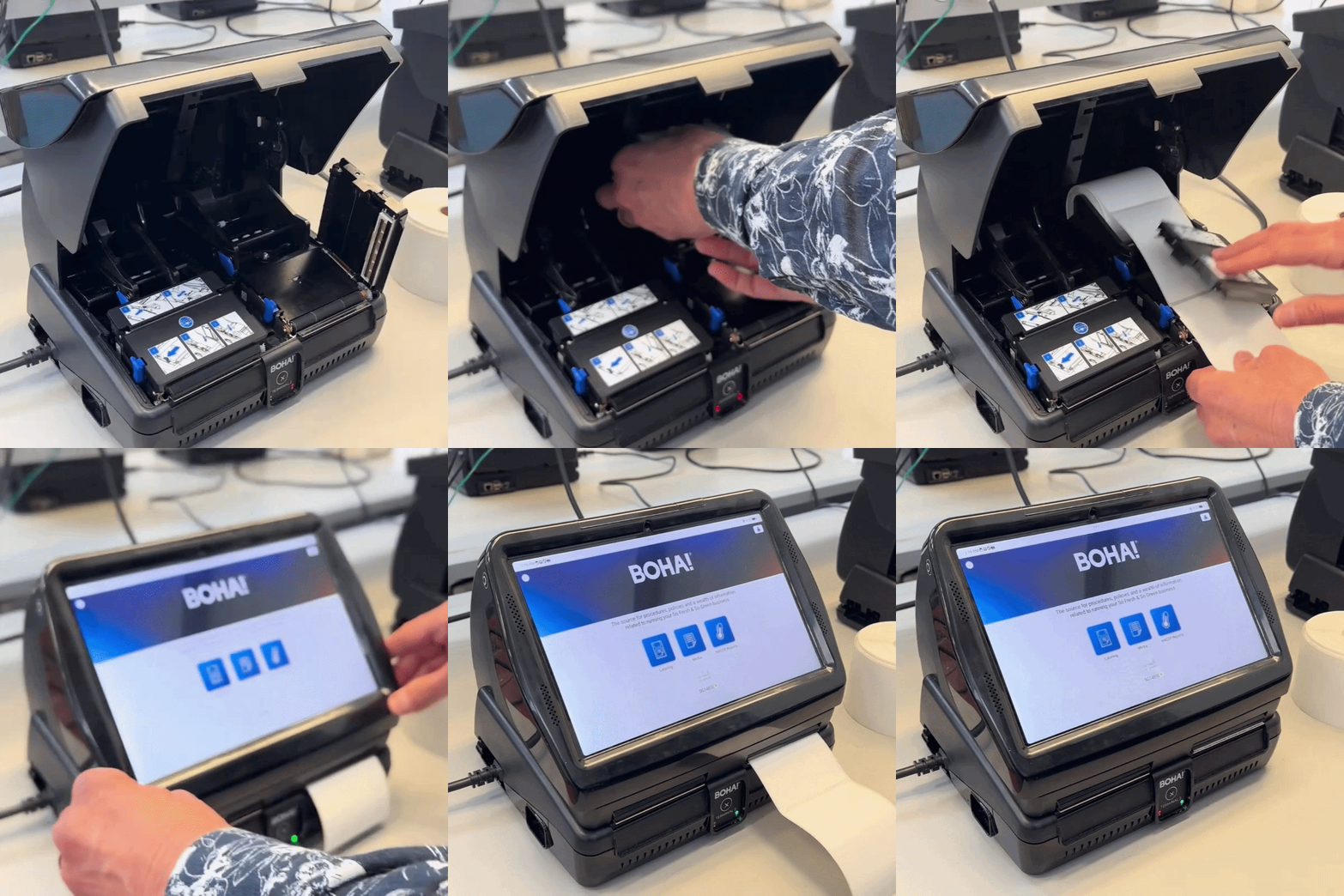
Quick label roll replacement helps teams keep the T2 station ready during high-volume labeling work.
Customer-facing grab-and-go labels often need more information than internal prep labels, especially when items are packaged for coolers, displays, or checkouts. The label format changes from item to item, but the job does not. Staff need a reliable way to produce the right label without falling back on handwriting, manual calculations, or whatever unique process the person on shift uses to complete the task.
When those needs come through one fixed station, labeling is easier to keep consistent. T2 gives teams a clear place to produce readable labels, follow the same workflow, and avoid the mix of handwriting, manual date math, and shift-by-shift habits that can make labeling harder to control.
How high-volume printing supports busy prep environments
Back-of-house labeling is not low-volume work. Once work starts, labels may be needed again and again for ingredient prep, food storage, grab-and-go products, timer reminders, and anything else moving through the operation.
A labeling station has to keep up with that pace without becoming another bottleneck. If the hardware is slow, hard to use, or constantly interrupted by roll changes and setup issues, labeling starts to slow things down, feeling separated from the work instead of part of it.
BOHA! T2 is designed for high-volume label output in back-of-house environments. Its fixed touchscreen-and-printer design gives teams a dedicated place to access BOHA! Labeling, select the right workflow, and print the label they need from the same station.
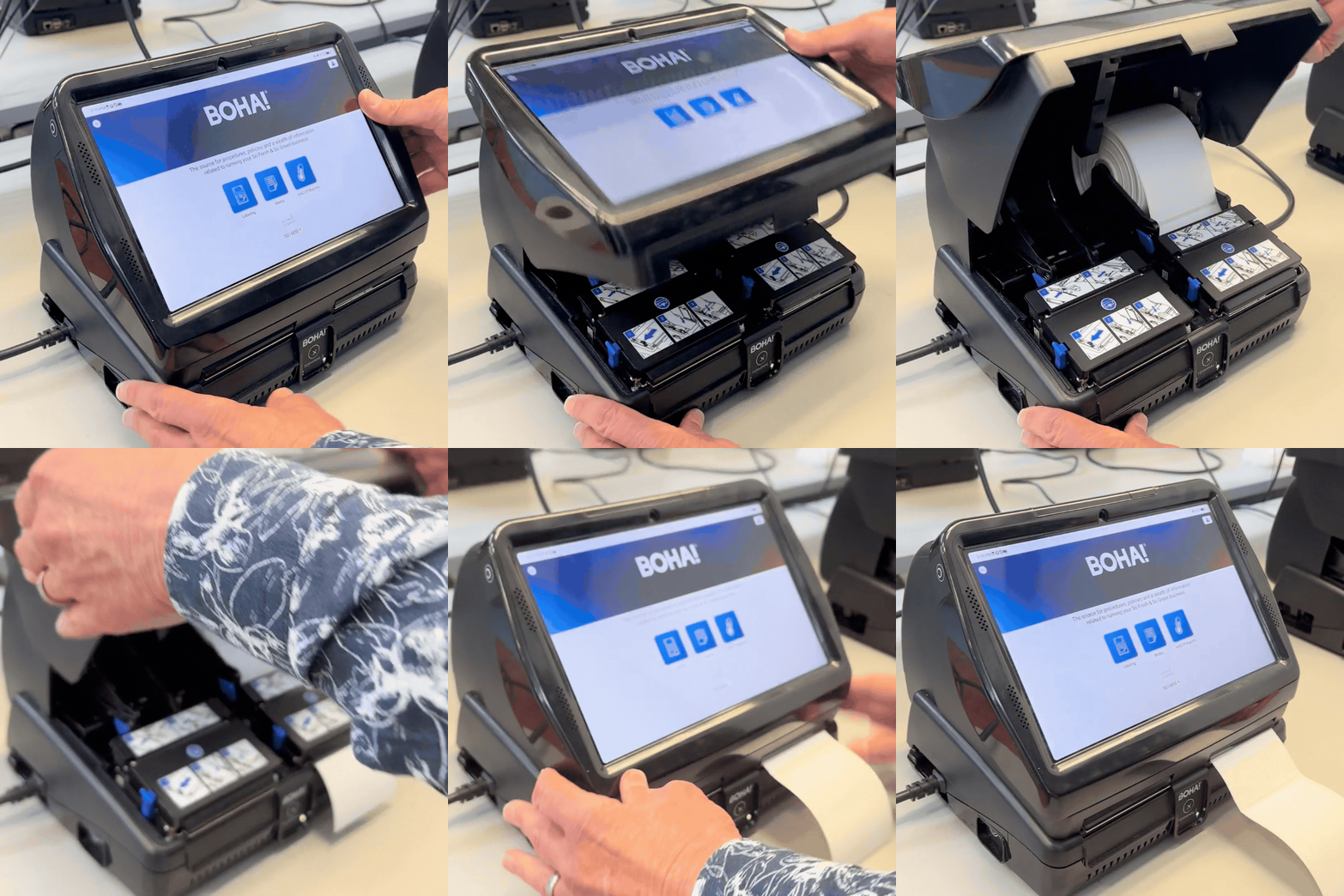
Easy access to the printer area helps simplify routine hardware tasks during daily back-of-house use.
For busy kitchen environments, several hardware details can shape the experience:
- Frequent label output for repeated prep, storage, and grab-and-go workflows
- Dual quick-swap thermal printer mechanisms that support two label types at once
- Label capacity that helps reduce unnecessary interruptions and frequent refills
- 300 dpi print brings clarity for easy readability
- Print speed that keeps up with busy prep windows
- A kitchen-ready design intended for daily back-of-house use
In a busy prep environment, those details are not just specs on a product page. They influence how easily labeling fits into the shift.
When label output is quick and easy to access, teams are less likely to treat labeling as something to circle back to later. When labels are clear, staff and customers can read the information more easily. When the hardware stays fixed and dedicated, the process is less dependent on who happens to be working that day.
Flexible label support from one anchored station
A fixed station does not have to mean a limited labeling program.
The hardware stays anchored, but the labeling workflows needed can vary by item, program, menu, or use case. Teams can print date-code labels for internal prep and storage, grab-and-go labels that carry ingredient, allergen, barcodes and nutritional information for packaged foods that need to move through checkout workflows.
BOHA! T2 gives operators a way to support that range from one shared station.
Its dual thermal printer mechanisms enable teams to use different label media from the same fixed device, depending on the operation’s configuration. That means teams can support more than one type of back-of-house labeling workflow without turning every label format into a separate hardware problem.
For operators, that is a useful balance. T2 gives those workflows a consistent physical place for execution that enables their labeling program to adapt to what the operation needs.
Why BOHA! T2 is more than a printer
Calling BOHA! T2 a label printer is accurate, but incomplete.
In the back-of-house, the value is not only that a label comes out. The value is that the team has a fixed place to follow the labeling process, use the approved format, and produce the label while the work is still moving.
That’s a different role than a printer sitting on a counter.
BOHA! T2 brings user interface and print output together in one anchored station. A new employee does not need to figure out which device to use or how the hardware is set up. Managers have a consistent workflow they can train around. Operators have a practical foundation for more standardized food prep and labeling workflows.
For organizations managing multiple locations, that consistency becomes even more important. A label design may be created or approved centrally, but it still has to be used correctly at the store level. T2 helps bring that approved labeling workflow into the back of house in a way that staff can use during their shift across multiple locations simultaneously.
The hardware is not there just to add another device to the kitchen. It consolidates multiple devices into one, giving critical labeling workflows a fixed place to happen, which makes them easier to repeat across teams, shifts, and locations.
A fixed starting point for a broader BOHA! story
BOHA! T2 is not the full BOHA! platform. It’s not meant to carry the entire value story by itself.
But it’s a powerful place to start.
For restaurants, convenience stores, campus dining, hospitality, prepared food programs, franchise systems, and multi-location foodservice operators, BOHA! T2 offers a practical way to improve the labeling experience in the back-of-house. It helps answer a common operational question: how do you make labeling easier, faster, more consistent, and more reliable for the people doing the work?
A fixed, anchored labeling hub is part of that answer.
By combining a touchscreen interface, integrated printing, flexible linered label support across many label types, kitchen-ready design, and high-frequency label printing capability, BOHA! T2 gives operators a strong hardware foundation for standardized food prep and labeling workflows.
For teams learning about BOHA! by TransAct for the first time, BOHA! T2 provides a clear first look at what the broader system is built to support: practical automation, reliable execution, easy repair, workability, and more consistent back-of-house workflows.
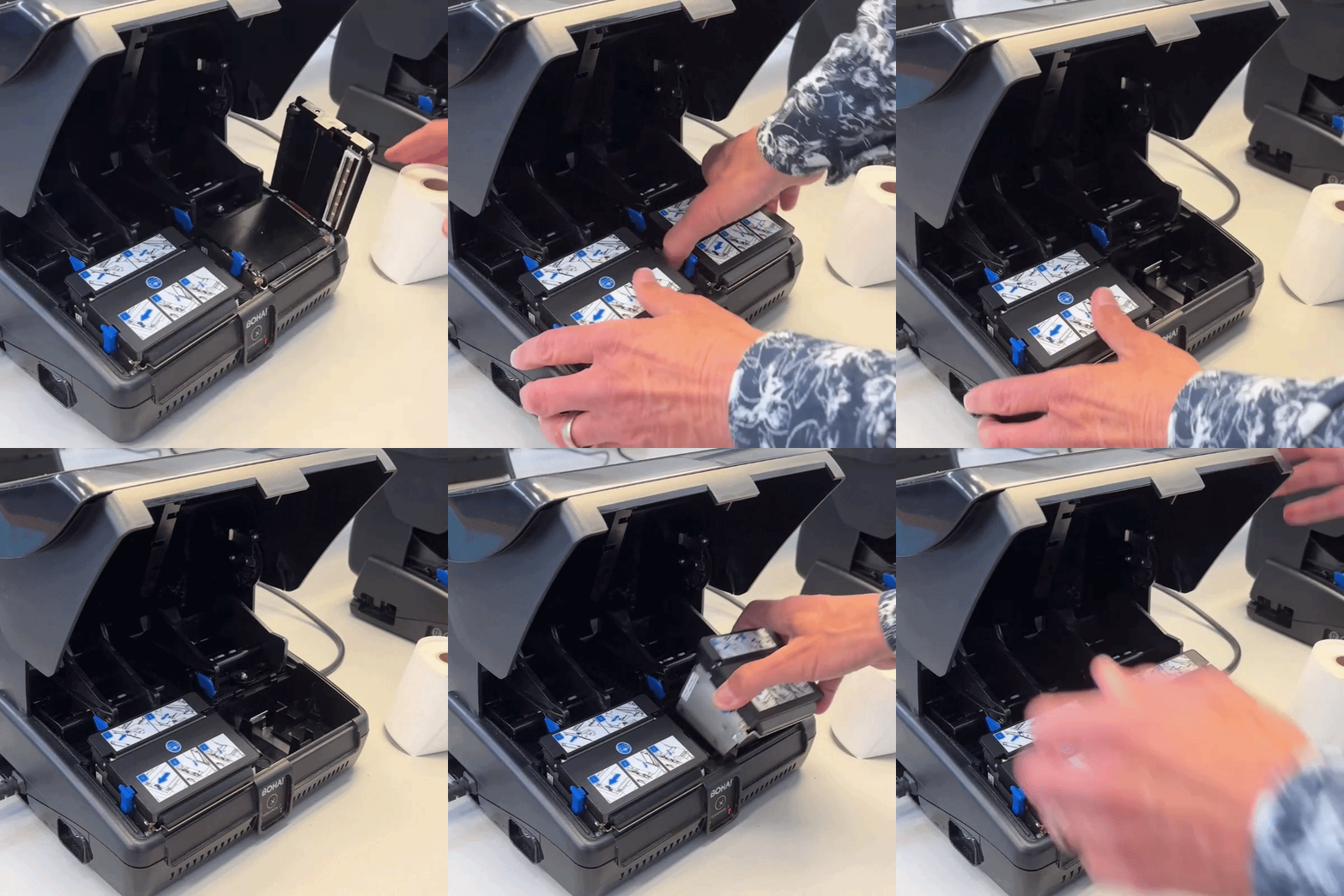
Dual quick-swap thermal printhead modules are designed to make servicing more straightforward when a print mechanism needs attention.
Best fit for BOHA! T2
BOHA! T2 is best suited for foodservice operations that need a fixed, shared labeling station for repeated label printing across prep, storage, grab-and-go, and food rotation workflows.
BOHA! T2 is best suited for operations needing:
- A fixed labeling station
- High-volume label output
- Leverage multiple label types or need extra capacity for high throughput
- Consistent shared access for multiple employees
- A screen and printer that stay together
- Standardized food prep and labeling workflows
- Date-code, grab-and-go, and made-to-order labeling across various media types
- Hardware that stays anchored in one back-of-house location
For teams that want a reliable, dedicated place to manage frequent labeling work, BOHA! T2 provides the hardware foundation.
Next in the BOHA! Built series
T2 is a fixed labeling workhorse, but labeling is only the first layer.
In the next article in the BOHA! Built series, we’ll look beyond label output and explore how BOHA! T2 connects to broader BOHA! workflows across food prep, checklists, timers, training, and back-of-house execution.
Frequently asked questions about BOHA! T2
Here are a few common questions about BOHA! T2, formerly known as BOHA! Terminal 2, and how it supports fixed back-of-house labeling workflows.
What is BOHA! T2?
BOHA! T2, formerly known as BOHA! Terminal 2, is a fixed back-of-house terminal and high-volume label printer that helps foodservice teams produce labels for prep/date coding, grab-and-go, and other food management-related workflows through BOHA! Labeling.
What types of labels can BOHA! T2 support?
BOHA! T2 can support a range of foodservice label types, including date-code labels, and grab-and-go labels (including made-to-order, nutritional fact panels, ingredient and allergen lists, and barcodes), on dissolvable, permanent, removable, and variable length media types.
When is a fixed labeling station useful in foodservice?
A fixed labeling station is useful when teams need a consistent, shared place to print labels regardless of prep windows, shift changes, production routines, and evolving prepared food programs. It gives labeling a reliable location and helps teams repeat the process more consistently.
How is BOHA! T2 different from BOHA! WorkStation?
BOHA! T2 keeps the screen and printer together in a fixed station. BOHA! WorkStation offers a detachable tablet for operations where staff need to bring the screen to the point of work.
Is BOHA! T2 only a label printer?
No. BOHA! T2 includes integrated label printing, but it is better understood as a fixed hardware hub for back-of-house labeling execution. It gives teams a consistent place to access labeling workflows, select the right label, and print it during daily operations.